


Brazilian farmers have turned overwhelmingly pessimistic about the outlook for 2027 following the presidential election, with most expecting tighter credit conditions and planning to scale back investment, according to a survey conducted by agricultural technology company Grão Direto.
The survey, conducted for The AgriBiz through Grão Direto’s grain-market intelligence platform Grainsights, questioned 323 farmers across 14 states on Oct. 27, two days after the election.
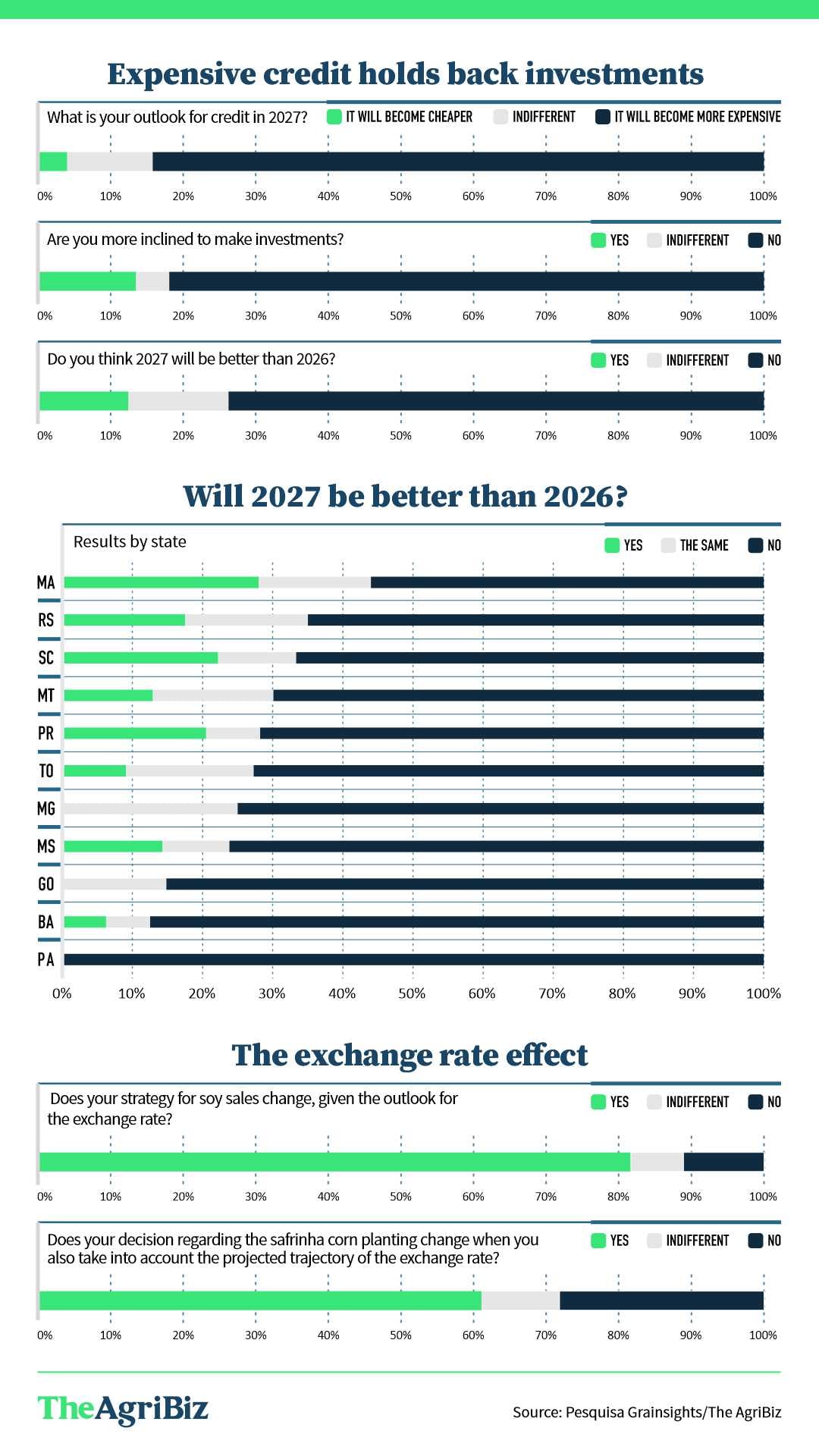
Some 84% of respondents expect borrowing costs to rise further in 2027, while 83% said they do not intend to increase investment compared with 2026. Another 74% said they do not expect next year to be better than the current one.
The pessimism is widespread. A total of 61% of respondents simultaneously said they would not increase investment, did not expect 2027 to improve and anticipated more expensive credit.
Only 5% qualified as fully optimistic, saying they planned to invest more and expected better conditions next year.
The gloomy outlook persists despite a sharp rally in the US dollar against Brazil’s real, which typically boosts local-currency revenue for exporters and farmers selling dollar-linked commodities.
Farmers’ Decisions
Nearly 80% of surveyed farmers said exchange-rate expectations influence their grain-marketing strategies. The dollar surged 9% against the real last week, closing at 5.44 reais on Friday, Oct. 30.
Currency movements are also expected to influence planting decisions for safrinha corn, the second crop planted on the same land after the soybean harvest, according to 60% of respondents.
While a stronger dollar generally supports farmers’ revenues, it also raises the local-currency cost of dollar-linked inputs, including fertilizers, seeds and crop-protection chemicals.
Ruan Sene, head of market intelligence at Grão Direto, said farmers’ pessimism was reflected in subdued trading activity last week, even as the dollar strengthened.
He attributed the limited volume of transactions to growers’ caution over the development of the 2026/27 crop amid a strong El Niño weather pattern.
“Farmers have already sold much of the soybeans they were willing to commit before gaining greater clarity on how the 2026/27 crop will develop,” Sene told The AgriBiz.
Many growers had already taken advantage of price increases in recent months to sell part of their expected production ahead of harvest.
In Mato Grosso, Brazil’s largest agricultural producing state, soybean farmers had sold 43.7% of their projected 2026/27 crop by the end of September.
That compares with 31.4% at the same point last year and a five-year average of 33.2%, according to Imea, Mato Grosso’s farm economics institute.
Forward sales of safrinha corn, meanwhile, were broadly in line with both last year’s pace and the five-year average, at approximately 19%, according to Imea.
The pace of advance corn sales is an indicator of farmers’ willingness to purchase inputs ahead of planting early next year.
Regions
Pessimism was particularly pronounced in Pará state, where every farmer surveyed said 2027 would be worse than 2026.
Maranhão had the highest proportion of optimistic respondents, with 28% expecting a more prosperous year. Even there, however, a majority of 56% anticipated worse conditions in 2027.
In the top growing state Mato Grosso, 70% of respondents expected next year to deteriorate, while 13% anticipated an improvement.
Mato Grosso accounted for the largest share of survey participants, representing 28% of responses.
It was followed by Rio Grande do Sul and Paraná, each with 12%, Goiás with 8%, and Mato Grosso do Sul with 6.5%.
The findings underscore the cautious mood among Brazilian grain producers as they weigh rising financing costs, currency volatility and weather risks ahead of the next growing season.
This story was translated from the original Portuguese with the assistance of artificial intelligence and reviewed by The AgriBiz editorial staff.


